How many restrooms does a festival need?
Start with headcount and duration, not a guess. OSHA's construction ratio in 1926.51(c)(1) calls for 1 toilet per 20 workers, and while that standard governs job sites, festival planners in Bowling Green use the same math as a floor: more units for longer hours, more for alcohol service, more if there's one main stage everybody funnels toward at set break. A single-day event with a beer garden runs heavier than a quiet daytime craft fair. We size mixed fleets, usually standard units for the general crowd, a few deluxe flushable units near VIP or sponsor tents, and accessible units placed on a route that meets the 36 inch clear width in ADA Standards section 403.5.1. Every accessible unit we set also clears the 32 inch door opening required under ADA Standards section 404.2.3, and we leave a 60 inch turning circle per ADA Standards section 304.3.1 so a wheelchair can turn without backing into a fence line. If your event pulls from Plum Springs or Plano, both under 8 miles from downtown Bowling Green, expect walk-up traffic that adds to your resident headcount, not replaces it. Not sure where to start counting? Our porta potty calculator guide walks through the math step by step, and our placement guide covers sightline and traffic flow once you have a number.
What restroom options work best for festivals?
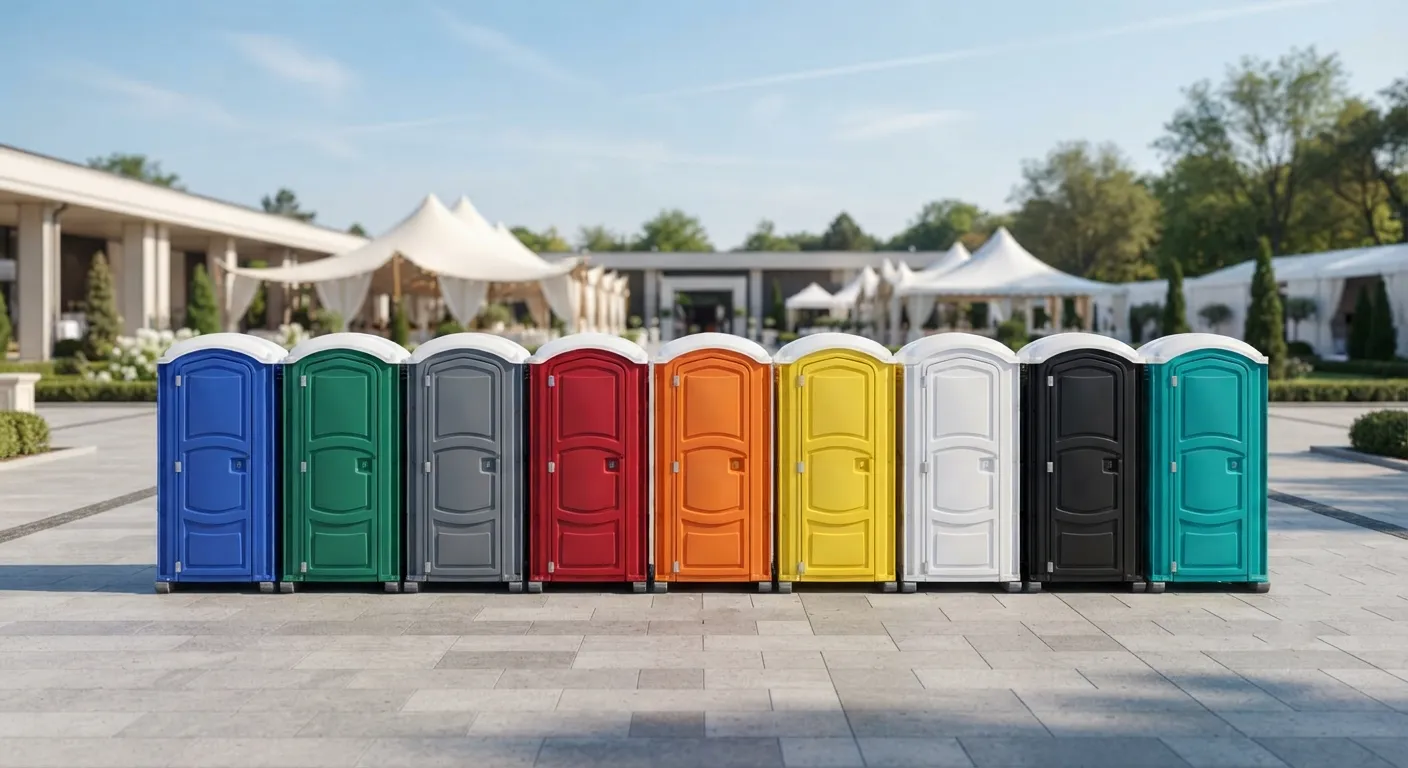
Standard units handle the general crowd, restroom trailers handle anyone paying a premium ticket price, and most Bowling Green festivals mix both rather than picking one. A standard porta potty rental runs 100 to 350 dollars a day depending on service level, and for a multi-day festival weekend, expect 125 to 400 dollars in that weekend window, cheaper per day than renting fresh units each morning. If your event has a sponsor tent, VIP ticket tier, or a wedding-adjacent reception on festival grounds, a restroom trailer rental with real sinks and flush toilets changes the guest experience entirely. A 2 stall restroom trailer suits a smaller VIP area; an 8 stall restroom trailer handles a headline stage crowd. Handwashing matters here too: 29 CFR 1910.141(d)(2) requires soap and towels or a hand dryer at wash stations, not sanitizer alone, so we pair units with handwashing station rental or standalone portable sink rental near food vendor rows.
| unit | duration | low | typical | high |
|---|---|---|---|---|
| standard | day | 100 | 150 | 350 |
| standard | weekend | 125 | 250 | 400 |
| standard | event | 200 | 400 | 800 |
| ada | weekend | 199 | 240 | 300 |
| trailer | weekend | 900 | 2000 | 3000 |
| trailer | event | 2499 | 3500 | 3899 |
Food vendors handling grease need attention too: a grease trap pumping visit before a multi-day run keeps interceptors from backing up mid-festival, since a trap is serviced once fats, oils and solids reach 25 percent of liquid depth.
Why does festival timing change the setup?
Because a one-day fair and a three-day music festival load restrooms differently, and service intervals have to match. ANSI/PSAI Z4.3 sets a baseline service interval of once per week for up to 10 users over a 40 hour stretch, but a festival compresses that same user count into 8 or 10 hours a day, so we service more often on multi-day bookings rather than sticking to a weekly clock. We also plan around lighting: OSHA's illumination guidance in 1926.56(a) covers minimum lighting for work areas, and for evening festivals we pair restroom clusters with a light tower rental so the path stays lit after dark. Crowd flow around restroom banks benefits from temporary fence rental or crowd control barrier rental to keep lines from spilling into walkways, and a chain link temporary fence works well for perimeter separation between vendor zones and public restroom areas. Delivery access matters on tighter festival grounds too: a roll-off or trailer delivery needs about 60 feet of straight clearance behind the truck, which we confirm during your site walk. Placement in a public right of way, a common issue for downtown Bowling Green street festivals, needs confirming directly with the city; we don't guess on that. For grounds pulling from Woodburn, 12.5 miles southwest, or farther out toward Franklin or Scottsville, we build delivery timing into the quote so units land before gates open.
What's the earliest we should book restrooms for a festival?
Book as soon as your date and headcount are set, ideally 60 to 90 days out for anything over 1,000 attendees. Weekend and multi-day festival dates fill our trailer fleet first. A request a quote early locks pricing before peak season.
Do you provide handwashing stations separate from restrooms?
Yes. We offer standalone hand sanitizer station rental and full handwashing station rental units with soap and towels, which satisfies 29 CFR 1910.141(d)(2) near food booths, unlike sanitizer alone.
Can you service units mid-festival on a multi-day event?
Yes, and we build that into the quote. Multi-day festivals get scheduled service visits rather than a single weekly stop, matched to your actual attendance curve each day, not a flat calendar interval.
What if our festival grounds don't have paved access?
We still deliver. Ground surfaces need to be reasonably stable and firm, similar to the slip-resistant standard in ADA Standards section 302.1, so grass fields usually work fine if they're not saturated.
How far in advance do you need site details for permits?
As soon as possible. Permit rules vary and placement in a public right of way needs confirming with Bowling Green directly; we help coordinate but don't file on assumption. See our porta potty permit requirements page for what to gather first.
Next step
Get a delivery date
Tell us the address, the dates and the headcount. We size the order and confirm the route.